Western vs. Vedic Astrology: What's the Difference?
Have you ever wondered why your zodiac sign changes when you check your birth chart using Western and Vedic astrology? The answer lies in how these two traditions measure the zodiac. Both interpret the position of the planets at birth, but they use different systems and methods.
1. Western astrology: Understanding personality
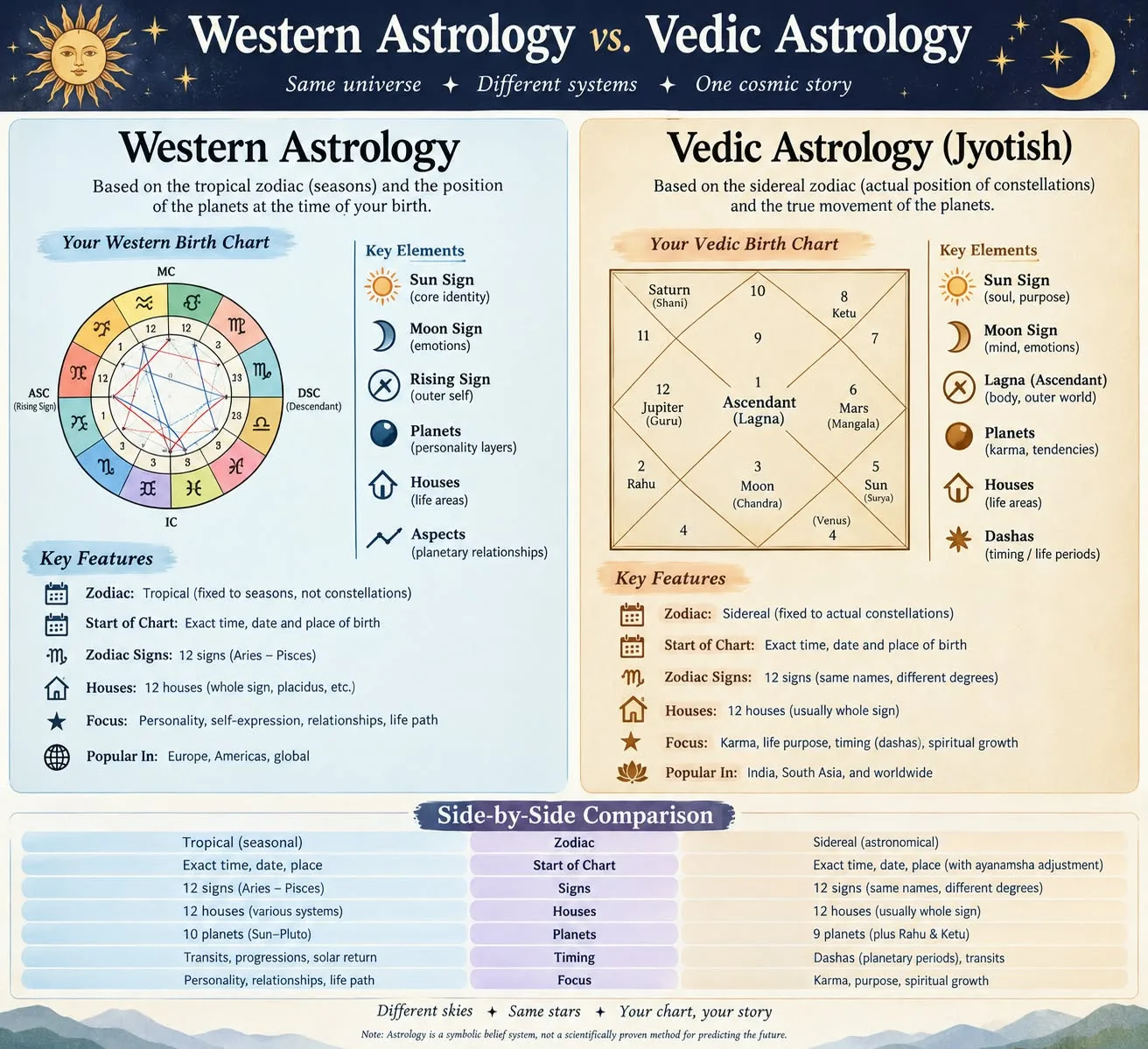
Western astrology commonly uses the tropical zodiac, which is based on the seasons and the spring equinox. In popular Western astrology, your Sun sign is often the main focus, helping describe your personality, emotional tendencies, strengths and challenges.
For example, someone born under Aries in Western astrology may be described as courageous, independent and energetic.
2. Vedic astrology: Understanding life patterns
Vedic astrology, also called Jyotish, originated in the Indian astrological tradition and commonly uses the sidereal zodiac, which is aligned with the position of the stars. It gives particular importance to the Moon sign (Rashi), the Ascendant (Lagna) and the 27 constellations called Nakshatras.
Vedic astrologers also use planetary periods called Dashas to interpret different phases of life.
3. Key differences at a glance
| Western astrology | Vedic astrology | |
|---|---|---|
| Zodiac system | Tropical | Sidereal |
| Popular starting point | Sun sign | Moon sign and Ascendant |
| Special techniques | Transits, aspects, progressions | Nakshatras, Dashas, planetary strengths |
| Common focus | Personality and self-understanding | Life patterns and timing |
4. Why can your zodiac sign change?
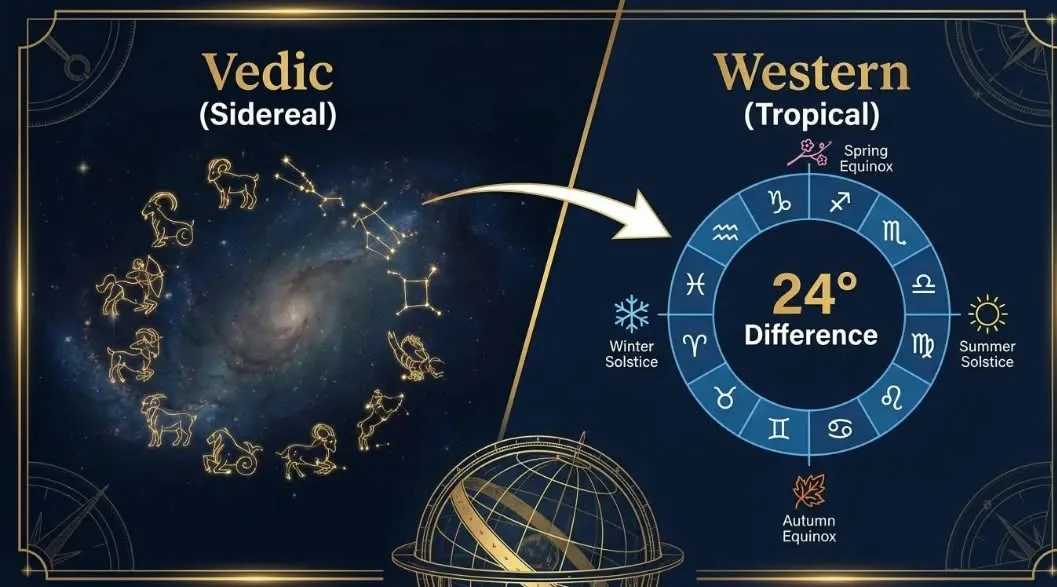
The two systems have gradually shifted apart because of Earth's axial precession. Their zodiac starting points currently differ by roughly 24 degrees, depending on the sidereal calculation used. As a result, a person who is an Aries in Western astrology may be a Pisces in Vedic astrology. Your complete birth chart is needed to determine your actual placements in each system.
5. How to find your Rising Sign (Ascendant)
Your Rising Sign, also called your Ascendant, is the zodiac sign that was rising over the eastern horizon at the exact moment you were born. In astrology it is associated with your first impression, outward personality and how you approach the world. It also opens your First House.
Follow these three steps:
- Find your birth date: your complete day, month and year.
- Know your exact birth time. Check your birth certificate or hospital records if possible.
- Enter your birth date, time and place into an online birth chart calculator.
Try these free resources:
- Astro.com: birth chart calculator
- Astrology.com: birth chart
- How to Find Your Rising Sign: our step-by-step guide
Important: Your Rising Sign can be different in Western and Vedic astrology because Western charts generally use the tropical zodiac, while Vedic charts generally use the sidereal zodiac. When calculating yours, select the zodiac system you want to explore. An accurate birth time is essential.
Conclusion: Which astrology should you follow?
Neither system needs to replace the other. Western astrology may appeal to you if you want to explore personality and self-reflection, while Vedic astrology offers its own detailed methods of studying planetary periods and life patterns.
The best approach is to understand how each system works and use astrology as a tool for reflection. Tarovaya's zodiac sign guides and daily horoscopes use the tropical zodiac, and you can see how they are calculated.