Four of Cups tarot card meaning
The Four of Cups examines dissatisfaction, emotional pause, and the choice to look again at what is available.
Quick answer
The Four of Cups can describe a pause when nothing offered seems to satisfy. You may feel bored, disappointed, guarded, or simply tired of deciding. The card does not say that you are ungrateful or that you must accept the next opportunity. It asks whether a refusal comes from clear values, temporary depletion, or an old expectation that no longer fits.
Its lesson is not forced optimism. Take time to notice what you need before you answer. A missed option can be reconsidered, and an attractive option can still be the wrong one. Attention creates room for a more honest choice.
Core themes
Contemplation, dissatisfaction, withdrawal, discernment, and emotional fatigue are common themes. Four can create structure, but it can also become a closed square. The card often appears when a person protects themselves from disappointment by looking only at what is lacking.
That protection may have a good reason. A recent loss, a crowded schedule, or repeated rejection can narrow anyone’s view. The Four of Cups asks for curiosity without demanding immediate enthusiasm. It makes space for the possibility that your feelings carry information.
Upright meaning
Upright, the Four of Cups may signal a period of waiting before a decision. A job offer may feel misaligned. An invitation may arrive when you want solitude. A familiar routine may no longer restore you. Instead of treating the mood as a flaw, identify the exact source of resistance.
Review what is on offer in plain terms. What does it require? What does it give? What would you lose by saying yes or no? A short walk, a list, or a conversation with someone outside the situation can separate a temporary low mood from a durable preference.
Reversed meaning
Reversed, this card can suggest emerging from a stalled emotional state. You may notice an opportunity you previously ignored, admit that isolation is no longer helping, or decide to make a modest change. It can also show the opposite pattern: a restless search for novelty because sitting with disappointment feels difficult.
Move slowly enough to learn from the shift. If you want to rejoin a project or reconnect with someone, be direct about what changed. If you feel pressure to seize every option, set a pause before you commit. New interest is valuable when it is paired with practical judgment.
Love and relationships
For relationships, the Four of Cups can point to emotional distance, familiar frustrations, or uncertainty about whether to engage. It may describe someone who needs quiet after conflict. Use the card to prepare a grounded conversation. What need has gone unnamed? What behavior has made closeness harder? What would a workable repair look like? Do not use silence as proof of what someone means.
Career and money
In career questions, this card may reflect burnout, a lack of challenge, or doubt about an opportunity that looks acceptable on paper. It can encourage a careful review of work conditions, learning options, and the value you place on your time. For money, boredom can lead to impulse purchases or ignored paperwork. Create a small reset: review recurring costs, open the statement you have postponed, or schedule time to compare options.
Advice prompt
Set aside ten quiet minutes and write three headings: “what I am tired of,” “what I miss,” and “what I might be overlooking.” Keep the answers concrete. You might discover that you need rest, a different challenge, an honest no, or a request for more information.
Afterward, take one low-risk action. Reply to the message you have delayed, ask a question about the offer, or clear one small task. The aim is not to transform your mood. It is to give your attention a direction that respects your pace.
Yes/no context
In a yes/no reading, the Four of Cups usually calls for a pause rather than a quick yes. More information, rest, or a clearer question may be needed before you decide. A delayed answer is not automatically a lost chance.
Ask what would make the choice easier to evaluate. Compare real costs, consent, timing, and alternatives.
Related study
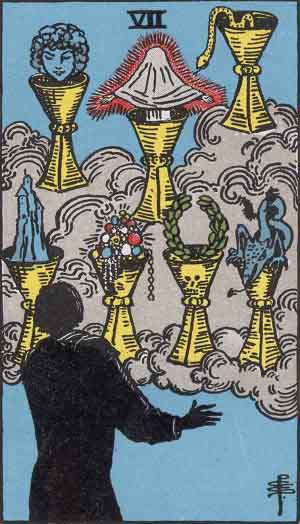
The Eight of Cups also considers dissatisfaction, but it focuses on the choice to leave something behind. The question guide can help you turn a vague sense of refusal into a specific inquiry with facts you can check.
Four of Cups at a glance
What does Four of Cups mean upright?
The Four of Cups may signal a period of waiting before a decision. A job offer may feel misaligned.
What does Four of Cups mean reversed?
This card can suggest emerging from a stalled emotional state. You may notice an opportunity you previously ignored, admit that isolation is no longer helping, or decide to make a modest change.
What does Four of Cups mean in love?
The Four of Cups can point to emotional distance, familiar frustrations, or uncertainty about whether to engage.
What does Four of Cups mean for career and money?
This card may reflect burnout, a lack of challenge, or doubt about an opportunity that looks acceptable on paper.
Is Four of Cups a yes or no card?
Not yet or unclear
The condition is clarity: identify what you are actually responding to and what the offer truly contains.